
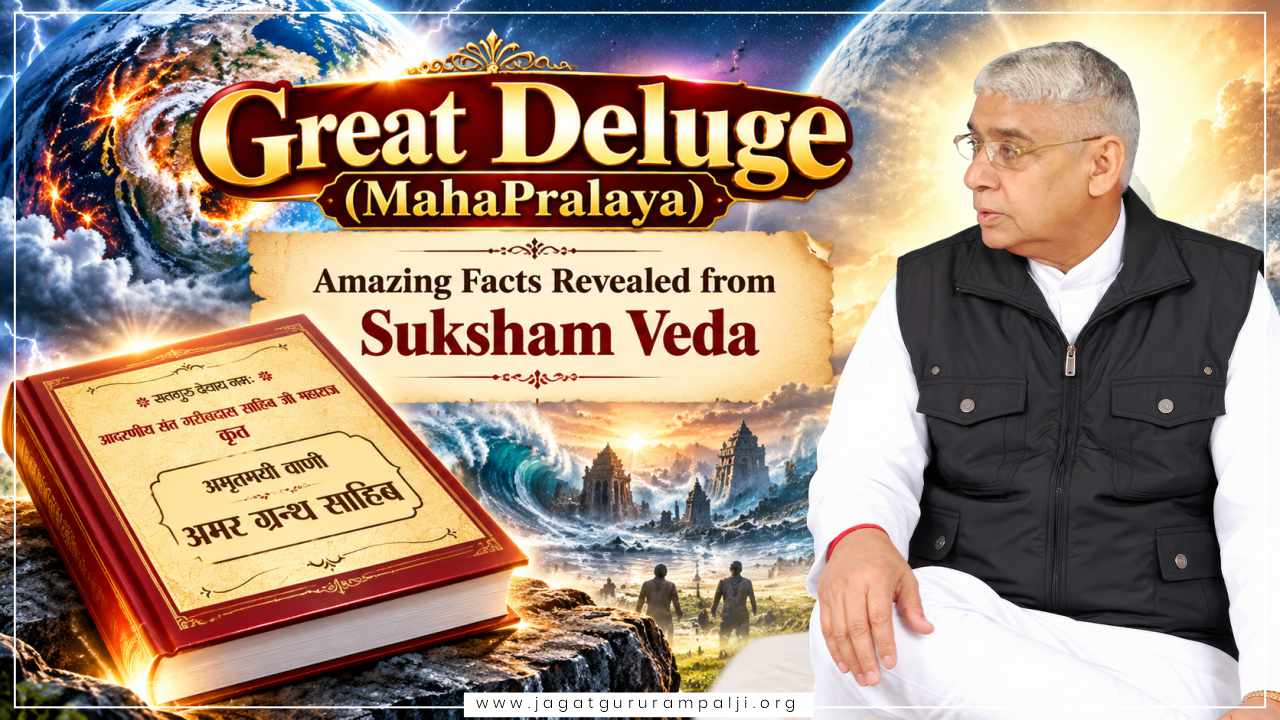
A precise analysis of every aspect of spirituality is found only in the Sukshma Veda. Examples illustrating every unresolved aspect from the origin of the universe to its destruction and recreation are presented in the Sachidanand Ghan Brahm’s speech which resolves a profound myth prevailing in many religious beliefs which certifies that the concept of great deluge (Mahapralaya) is a true phenomenon in the cosmic cycle.
This cycle of creation and destruction in the universe does not run on its own; rather, it is a pre-determined and well-ordered system governed by the immortal supreme power, Almighty Kavir Dev. His word power governs all activities in the universe.
The Supreme God’s power of the Word is a force capable of transforming every particle of the universe, from the physical realm to the subtle dimensions. It is the Word that possessed the potency to create infinite universes out of the void.
The speech from Suksham Ved certifies the same.
Swarg rasatal Lok kusatal, rache Jami asman re। 14 tabak kiya chhin mahi, sirje shashi aru bhaan re।।
Meaning: The supreme God created heaven, the netherworld, all 14 realms, the Sun, the Moon etc. within seconds with His word power. He is so capable.
Similarly, at the stipulated time by the order of the same divine (Param Akshar Brahm/ Satyapurush) there occurs great devastation in 21 universes of Satan Kaal.
Here the question arises
- Why the cycle of creation and destruction of the universe?
Hence, the focus of this article is to provide true information about the need and the process of ‘Mahapralaya'/ catastrophe which happens in the cosmos. This article will be an eye-opener for those spiritually blind people who consider creation and destruction of the universe a pure myth since they lack true spiritual knowledge of the Almighty God. Such ignorants will get a descriptive answer backed by evidence from authentic holy scriptures to some frequently asked questions.
- What does great destruction mean?
- What is the great flood in Hinduism?
- What exactly happens in a great flood?
- Is a catastrophe a disaster?
- What are types of destruction?
- What is the great tribulation in the Bible?
- When will the great devastation start?
- What is the great deluge in Greek mythology?
- Is there proof of the great flood of Noah?
- What is the concept of the end of creation?
So let's move ahead and based on the following points try to get answers to all questions related to ‘Maha Pralaya’.
- Unraveling the Mystery of Creation and Maha Pralaya
- What is the difference between Pralaya and Mahapralaya?
- What will happen at the end of Kalyiga?
- Evidence of Pralaya in pious Quran Sharif
Note: The reference has been taken from the spiritual discourses of Jagatguru Tatvadarshi Sant Rampal Ji Maharaj, Suksham Veda Kabir Sagar, sacred book ‘Gehri Nazar Gita Mein', holy Bible, pious Quran Sharif and Shrimad Bhagavad Gita.
Unraveling the Mystery of Creation and Maha Pralaya
The first and foremost concept to understand here is
- Where is the evidence of creation of the universes and its destruction?
The truth of the universe's creation according to all religions mentioned in their respective authentic holy books provides an answer to this intriguing question. Suksham Ved Kabir Sagar, the most authentic holy scripture which is the collection of nectar speeches of Sachidanand Ghan Brahm brings forth few facts related to creation which were never revealed before.
- The creator of the entire universe is Almighty Kabir. Evidence is in pious four Vedas. Also in Gita Adhyay 15 Shlok 1-4
- In this world, there are two types of Gods. Perishable and imperishable.
- Param Akshar Brahm/ Purna Brahm/ Satpurush Kavir Dev is imperishable. Whereas ParBrahm/ Akshar Purush and Brahm/ Kshar Purush are perishable. (Evidence Gita Chapter 15 Verse 16&17)
- Akshar Purush is the Lord of only seven Sankh (700 quadrillion) universes (Rigved Mandal 10 Sukt 90 Mantra 2)
- Kshar Purush/ Jyoti Niranjan is the Lord of only 21 universes (Rigved Mandal 10 Sukt 90 Mantra 1)
- Satpurush Kabir Sahib is the Lord of infinite universes including the realms of both these perishable Gods (Rigved Mandal 10 Sukt 90 Mantra 3)
- All souls residing in these three realms belong to Param Akshar Brahm. God Kabir is the father of all souls.
- The souls are imperishable whereas their material bodies are perishable be it in human form or animal form.
- A lot many souls committed a blunder in Satlok/ Sachkhand being infatuated by Kshar Purush/ Kaal hence willingly agreed to come along with him in his 21 universes.
- Similarly, a lot of souls came to the realm of ParBrahm.
- Brahm Kaal and Goddess Durga are husband and wife. Rajgun Brahma, Satgun Vishnu, Tamgun Shiva are three sons of Kaal and Durga/ Ashtangi (Bhagavad Gita, Adhyay 14 Shlok 3 to 5 and Markandeya Purana)
- All the souls residing in these two perishable realms suffer the pain of birth-rebirth whereas the souls residing in immortal abode Satlok/ Sachkhand never take birth and die.
- God Kabir is the ocean of happiness and mercy. He constantly makes efforts to bring His beloved souls trapped in these two perishable worlds back to their native place Satlok and relieve them from the tyranny of 84 lacs life forms and birth-death.
- In this process of accomplishing His task God Kabir as Satguru comes to the realm of Kaal, grants His true spiritual knowledge and true salvation mantras and liberates His beloved children (Gita Adhyay 15 Shlok 4)
The evidence for all above points is also found In pages 690 to 692 of the chapter 'Adi Ramani' from the ‘Amargranth Sahib' of the revered Saint Garib Das Sahib Ji, pious Quran Sharif Surat Furkani 25 Aayat 52-59, holy Bible Genesis, Shri Guru Granth Sahib and at several other places in certified holy scriptures of all religions. This is in nutshell the creation. Moving ahead we will know about the great deluge/ Maha Pralaya.
What is the Difference Between Pralaya and Maha Pralaya?
Description of the Great Deluge
Ref: Kabir Sagar, Gyan Sagar
What is Pralaya?
It is to note that whatever has originated within the twenty-one universes of the ‘Kshar Purush’ (the Perishable Being) is bound to be destroyed at the appointed time. This is the law of Kaal's realm.
In the cosmos there are three types of Cataclysms.
One is done by Kaal (Jyoti Niranjan). At the end of the Mahakalpa, when Kaal's eldest son Rajgun Brahma dies. This is the periodic destruction/ Pralaya which makes way to new creation.
What is a Mahakalpa?
Lord Brahma's night lasts for one thousand Chaturyuga and the day for the same period. Thirty days and nights make one month, twelve months make one year, and Brahma's life lasts for one hundred years. This is called a Mahakalpa.
What is Divine Mahakalpa?
Second Great Deluge
After the death of seven Brahmas, one Vishnu dies. After the death of seven Vishnus, one Shiva dies. This is called the Divine Mahakalpa.
In this event, Brahma, Vishnu, and Shiva, along with the beings of their realms, and other creations and their beings in heaven, hell, and the netherworld, are destroyed. At that time, only the Brahmaloka remains, in which the Kaal God (Jyoti Niranjan) and Durga reside in three forms: Mahabrahma-Mahasavitri, Mahavishnu-Mahalakshmi, and Mahashankar-Mahadevi (Parvati), creating three realms. Within this Brahmaloka, a Mahaswarga has been created, inhabited by beings who have attained the fourth level of liberation.
Souls like Markandeya and Rumi Rishi, who have attained the fourth level of liberation and are called Brahma-Leen, are beyond the range of the divine vision of the seekers of these three realms. The sages of heaven, hell, and netherworld cannot see them. Therefore, they are considered Brahma-Leen. But they go to the great heaven created in Brahmaloka.}
Then, at the beginning of the divine Mahakalpa, Lord Kaal (Jyoti Niranjan) recreates the universe below Brahmaloka. Lord Kaal creates his three sons (Rajgun Brahma, Satgun Vishnu, Tamgun Shiva) through sexual intercourse with his own Prakriti (Maya - Adi Bhavani), Mahasavitri, Mahalakshmi, and Mahadevi (Gauri). This Lord Kaal renders Brahma, Vishnu, Shiva unconscious with his power. Then, he places them in different locations: Brahma on a lotus flower, Vishnu on the bed of Shesh Nag in the ocean, and Shiva on Mount Kailash.
Churning of the Ocean and Marriage of Tridev
Kshar Purush, Kaal awakens triple Gods one by one. He orders them to churn the ocean through Prakriti (Durga). Then, this Mahamaya (Mool Prakriti/Sheranwali) takes three forms and hides in the ocean. They appear as three young women (young goddesses). All three sons (Brahma, Vishnu, and Shiva) marry these three goddesses. He assigns three divisions to his three sons: creation to Brahma, sustenance to Vishnu, and destruction to Shiva, thereby reviving the creation of Kaal (Brahma).
Note: This is described in detail in the holy Puranas, such as the Shiva Purana, Brahma Purana, Vishnu Purana, Mahabharata, Sukh Sagar, and Devi Bhagavad Purana, and briefly in verses 3 to 5 of the fourteenth chapter of the Gita.
Third Mahapralaya
In one universe, Trilokiya Shiv (Tamogun son of Kaal) dies 70000 times, then one universe gets destroyed and Kaal (Mahashiv) who lives in three places in Brahmalok also gives up his Mahashiv body. In this way, this destruction of one universe i.e. third Mahapralaya took place and at that time one Brahmalokiya Shiv (Kaal) dies and 70000 (seventy thousand) Trilokiya Shiv (sons of Kaal) die, i.e. creatures of all the worlds including Brahmalok created in one universe get destroyed. This time is called one era of ParBrahm i.e. Akshar Purush. In this way, the meaning of Gita Chapter 8 Verse 16 should be understood.
"Thus come three divine cataclysms":
First Divine Deluge
When the hundred (100) Brahmalokiya Shivas (Kaal-Brahm) die, then the creatures of the 20 universes formed in the four Mahabrahmands get destroyed.
Then he keeps the virtuous creatures (swan souls) of the four great brahmands in the fake Satyalok etc. worlds created in the twenty-first brahmand and makes other creatures unconscious and puts them in four other secret places created in the same world and then satisfies his hunger by eating creatures from the same fake Satyalok and keeps on making the creatures he eats unconscious in four secret places created in the same twenty-first brahmand and there also Jyoti Niranjan assumes his three forms (Mahabrahma, Mahavishnu and Mahashiv) and keeps on performing his divine act of birth and death in the Shiva form created there, by which he keeps the time fixed and dies a hundred times, due to which the time of hundred yugas of ParBrahm gets completed in the twenty-first brahmand.
Thereafter he starts the work of creation in all the four great brahmands.
Note: In one creation, the creation lasts for the age of hundred Brahmalokiya Shiv (Kaal) i.e. hundred Yugas of Parbrahm and the destruction lasts for the same time i.e. two hundred Yugas of Parbrahm (because in one Yuga of Parbrahm, one Brahmalokiya Shiv i.e. Kaal dies) in this one divine Mahapralaya which is done by Kaal.
This Kaal i.e. Brahm is called the first unmanifested (in Gita Chapter 7 Verse 24-25). The second unmanifested is Parbrahm and beyond this the second eternal unmanifested which is the complete Brahm, understand the meaning of Gita Chapter 8 Verse 20.
Second Divine Deluge
After this great cataclysm has occurred five times, there is a second divine cataclysm. The second divine great cataclysm is done by Parbrahm (Avigata Purush/Akshar Purush). In it all 21 universes including Kaal, that is, Brahm (Kshar Purush), are destroyed. In which the three worlds (Swargaloka-Mrityuloka-Patalaloka), Brahma, Vishnu, Shiva and Kaal (Jyoti Niranjan-Omkar Niranjan) and their worlds (Brahma Loka) i.e. all the other 21 universes are destroyed.
Special: - After the death of seven Trilokiya Brahma, one Trilokiya Vishnu dies and after the death of seven Vishnu, one Trilokiya Shiva dies. After the death of 70000 (seventy thousand) Trilokiya Shivas, the death of one Brahmalokiya Shiva i.e. Kaal (Brahm) occurs after one era of Parbrahm.
In such a thousand yugas, Parbrahm (Akshar Purush) has one day and the same number of nights. Then Prakriti (Durga) along with Kaal (Jyoti Niranjan) i.e. Brahm and its twenty-one Brahmand creatures come into destruction. Then the day of one thousand yugas of Parbrahm (second unmanifested) ends. After the passage of the same number of nights, Brahma again appears as Purna Brahma. Geeta Chapter 8 Understand the meaning of verse 17 like this. But the boundaries of the universes and the great universes and the worlds created within them (think of it as a circular wall) do not end.
Then after the same time, the Purna Brahma (Satya Purush) recreates Kaal and Maya (Prakriti Devi) on the basis of the creation karma predetermined by Him and creates all the creatures who are prisoners of Kaal, in their bodies on the basis of their karma as per the law of creation karma and it seems that Parbrahma is creating {Here, verse 17 of Gita Chapter 15 should be remembered in which it is said that the supreme God is someone else who is actually the indestructible God. Who enters all the three worlds and sustains everyone.
In verse 61 of Gita Chapter 18, it is said that the omniscient God rotates all the creatures like a machine on the basis of karma and is situated in the heart of every creature.
Readers of the Gita will again be confused that in verse 15 of Chapter 15 of the Gita, Kaal (Brahm) says that ‘I am situated in the heart of all living beings and I am the one who dispels all knowledge and gives the Vedas’.
In the heart lotus, Lord Kaal resides in the form of Mahashiv along with Mahaparvati (Durga) and the Supreme God also resides inseparably with the soul, just as air resides with the fragrance. Both have an inseparable relationship, but there is a difference in some qualities. There is a detailed description in verses 17 to 21 of Chapter 2 of the Gita.
In this way, the Purna Brahm also resides in the heart of every living being with the soul, just as the sun, despite being at a faraway place, has an effect of its heat and light inseparably on every living being, and the place of the soul is also the heart.
Important: The destruction of a single universe (a group of five universes) occurs after 100 years of the perishable God. The cataclysm lasts for the same number of years.
Understand Kaal i.e. Brahm (Jyoti Niranjan) like this, that in the summer season, in areas like Rajasthan-Haryana, a pillar of air (air mixed with soil) is visible very high in the sky and moves in a cyclical manner. Which is temporary. But the smell is inseparable with the air.
Similarly, understand the subtle relationship between the soul and the Supreme Soul. Similarly, understand that the sequence of all the Pralaya and Mahapralaya is definitely due to the Supreme God (Satyapurush, Kavirdev). After the completion of one thousand Yugas which is the night of ParBrahm, Kaal (Jyoti Niranjan) creation starts again according to the principles of time established by the word power of Satyapurush Kavirdev.
Akshar Purush (ParBrahm) on the orders of Purna Brahm (Sat Purush) sends Kaal (Jyoti Niranjan) and Maya (Prakriti i.e. Durga) along with all the living beings to the twenty one brahmands of Kaal and according to the law made by Purna Brahm, other creations take place in all the brahmands by the grace of Lord Kabir Ji. The illuminating (Noorani) body on the subtle body of Maya (Prakriti) and Kaal (Jyoti Niranjan) is also created by Purna Parmatma and the rest of the creation is done by Brahm (Kaal) through the union with his wife Durga (Prakriti). Niranjan creates the remaining space on the basis of five elements. Then the creation of Kaal (Jyoti Niranjan i.e. Brahm) begins. Thus this Parbrahm is called the second unmanifested.}
What is Maha Pralaya?
Mahapralaya' refers to a massive, cataclysmic event. In Hindu scriptures, it is considered the end of the cycle of creation, marking the destruction of the universe.
Third Divine Great Deluge
As we read in the aforementioned description, after the death of seventy thousand sons of Kaal (Brahm) in the form of Shiva, one Brahm (Mahashiv) dies. That period is an era of ParBrahm. Regarding this, in the Gita, Chapter 2, Verse 12, Chapter 4, Verses 5 and 9, and Chapter 10, Verse 2, the Lord, the giver of the knowledge of the Gita, says that
’I too am subject to birth and death. I have had many births, which even the gods (including Brahma, Vishnu, and Shiva) and the great sages do not know because they all originated from me’.
In the Gita, Chapter 4, Verse 9, it is said that ‘my births and actions are divine’. In one era of the Brahm, Kaal leaves the body of Lord Sadashiv and re-establishes himself in another universe in three other forms. He performs this spectacle himself. One day of the ParBrahma is one thousand eras, and the night is the same. Thirty days and nights constitute a month, twelve months constitute a year, and the ParBrahma (the second unmanifested) lives for a hundred years. At that time, ParBrahm dies. This is called the third divine Great Deluge. In this third divine Great Deluge, all universes and creatures, including the twenty-one universes of Brahm (Kaal), the seven conch universes of the ParBrahm, and countless other universes, will be destroyed. The conch will sound very loud (Dhundhukaar). All creatures and universes will be destroyed, but this third divine Great Deluge will occur after a long time.
That third (divine) Great Deluge will be carried out by Achint, the son of Satpurush, under the orders of his father, the Purna Brahm (Satpurush), according to the rules of creation and karma prescribed by the Supreme God. Then, the universe will be recreated.
However, the swans who have gone to Satlok will not be subjected to rebirth and death. In this way, neither Akshar Purush (ParBrahm) is immortal, nor Kaal Niranjan (Brahm) is immortal, nor Brahma (Rajgun), Vishnu (Satgun), Shiva (Tamgun) are immortal. Then how can their worshippers attain complete liberation? That is, never.
God Kabir is Third Eternal Unmanifested Being
Therefore, one should worship Purna Brahm, by worshipping whom the soul goes to Satlok (Amarlok). Then he never dies, becomes completely liberated. That Purna Brahma (Kavirdev) is the third eternal unmanifested being, which is described in verses 20, 21 of Chapter 8 of Geeta.
Amar karu Satlok pathaun, tate Bandi Chhor kahaun||
The proof of that same Supreme God is given in verse 17 of Chapter 2 of Geeta Ji, verses 14, 15 of Chapter 3, verses 13 and 19 of Chapter 7, verses 3, 4, 8, 9, 10, 20, 21, 22 of Chapter 8, verses 12 to 17 and 22 to 24, 27, 28, 30-31 and 34 of Chapter 13 and verses 31-32 of Chapter 4, verses 7, 19-20, 25 to 27 and also in verses 46, 61, 62 of Chapter 18, specifically, that by taking refuge in that Supreme God, the soul never comes into the cycle of birth and death again.
{ Important: To understand this act of Kaal, keep in mind the following detail: There is a Shiv Ji in the three worlds. He is the son of Kaal. He dies after the death of 7 Trilokiya Vishnu Ji and 49 Trilokiya Brahma Ji. Similarly, Lord Kaal also resides in the form of Mahashiva in the Brahmalok created in a universe. To maintain the time sequence of creation as per the time system created by God, this Mahashiv (Kaal) of Brahmalok also dies. When the 70000 (seventy thousand) Trilokiya Brahm Kaal's son Shiv dies, then a Brahmalokiya Shiv (Brahma/Kshar Purush) dies and is born under the influence of the time system created by the Supreme God. The time of death of this Brahmalokiya Shiv (Brahma/Kaal) is one era of ParBrahm (Akshar Purush). That is why, according to the Gita Ji, Chapter 2, Verse 12, Gita Chapter 4, Verse 5, Gita Chapter 11, Verse 2 of Chapter 10 states that 'you and I have had many births. I know, but you do not. My births are supernatural’.
At last a universe will be destroyed, and this Kshar Purush, Kaal, will also meet his end. All living beings within that universe will be struck by destruction. Water will cover the entire Earth, wherever land exists. Then, suddenly, eleven suns will come here, moving from the solar system, and burn everything to ashes.
After that, the Earth element will be consumed by the water element, the water element by fire, fire by air, and air by space. In this way, Brahm will die. This will mark one Yuga of Akshar Purush. This needs to be understood through mathematical calculations.
Also read What is the age of Gods?
What Will Happen at the End of Kaliyuga?
One Chaukri (Chaturyuga) in 21 universes of Brahm constitutes four Yugas.
1. Satyug, which is 1728000 years
2. Treta Yug, which is 1296000 years
3. Dwapar Yug, which is 864000 years
4. Kalyug, which is 432000 years.
Total 4.32 million human years.
At the end of Kaliyuga, a virtuous soul from the realm of Shri Vishnu Ji will incarnate as the tenth avatar under the name Nishkalank. By that time, Kaliyuga will have reached its peak. There will be frequent earthquakes. Trees will cease to sprout leaves and human beings and other creatures will have become extremely cruel, sinful, and unrighteous. People will turn away from devotion to God. Adultery, meat-eating, oppression, injustice, and other immoral practices will increase. People will no longer feel any shame or modesty and will openly engage in sinful acts and will begin eating raw food and raw meat.
Towards the end of Kaliyuga, the fertility of the Earth will also begin to disappear. The fertile layer of the soil will be depleted to a depth of 4.5 feet. Fruit-bearing trees will stop growing, and crops will no longer be produced. Suksham Ved states
Teen haath ansh kheench let Kalyug dharti ka, aur uge koi na beej, haal keh doon Prithvi ka||
Rainfall will become very scarce. Pollution will increase so much that rain will no longer fall normally but will appear more like drops of dew. Human lifespan will also decrease to approximately 20 years.
According to the descriptions given in the Sukshma Veda, people will pass through birth, youth, household life, and death at a very young age. Girls will reportedly begin giving birth to children at around five years of age. The child born will be approximately 6 inches. At that time, the bodies of all living beings will become very short. Human beings will reportedly be only about one and a half to two feet tall. Sin and oppression will become so widespread that most living beings will become deeply unrighteous. Nevertheless, some virtuous souls will remain who continue to fear God and engage in devotion even during that difficult period.
Those virtuous souls who devote themselves to God during the present Kaliyuga, live their entire lives according to moral principles, and remain steadfast on this path will attain Satlok. Those who follow the path of devotion but are unable to attain complete spiritual liberation will continue to receive human births in the future.
At the end of Kaliyuga, the tenth avatar, known as Nishkalank, will appear. This avatar will be born in the city of Sambhal, in the home of a Brahmin named Vishnudutt Sharma. He will be an extraordinary child whose body will be much stronger than that of ordinary human beings. He will carry a long sword and will destroy the cruel and wicked beings of Kaliyuga just as a farmer cuts wheat from a field with a crane. Only those people who still retain faith in God and fear of God at that time will survive.
The Nishkalank avatar is said to actually be the soul of King Harishchandra. King Harishchandra is regarded as a great truthful and righteous king of Satyuga. To uphold truth and his promise, he gave up his kingdom, sold his wife and son, and even sold himself, but he never abandoned the truth. Pleased with his sacrifice, God granted him a place in Vishnu Loka. Later, that same virtuous soul is said to be sent by Kaal to Earth as the tenth avatar.
The dialogue held between Shree Shukradev Ji and King Parikshit mentioned in Shri Vishnu Purana also tells about Kalki avtar.
In Chapter 4 Verse 5 & 9 of the Bhagavad Gita, Lord Kaal speaks about His many births, saying that Arjuna and He have had many births, but Arjuna does not know them, whereas the Lord knows all of those births. In verse 9 he says, his births and actions are therefore described as divine and extraordinary. He entered in the body of Shri Krishna as a ghost and did massacre in Mahabharata war. He sent Parshuram, entered in his body and killed several Kshatriyas. All sins were added in the bad account of Parshuram which he will have to bear later.
God Kaal performs various tasks through His aspects and sends different avatars to accomplish His work.
After the Nishkalank avatar destroys the wicked beings, a great transformation will begin for the virtuous souls who remain on Earth. Following this, extremely heavy rainfall will occur which will drown earth 20-30 feet. People will leave the plains and move toward the mountains, and hundreds of feet of water will cover the Earth.
After a long period, the water will gradually begin to recede. Along with the water, the infertile portion of the soil will rise to the surface, and over time the land will once again become fertile.
After this, forests will begin spreading across the entire Earth. Trees and plants will grow in great abundance, and the environment will gradually become cleaner. Trees will absorb carbon dioxide and release oxygen, gradually purifying the atmosphere and bringing about environmental changes on Earth.
Afterward, a new generation will be born from the virtuous souls who survived. Initially, the parents will be short in stature, while their children will be taller than them. The parents will be only two-and-a-half feet tall, while the son and daughter will grow to be four or five feet tall; then, the growth will gradually pick up. Gradually, the human body and height will increase.
In the Satya Yuga, humans attain heights of hundreds of feet and lifespans of hundreds of thousands of years. In this way, conditions on Earth will gradually change, and ultimately Satyuga will begin again.
Brahm Kaal intending to mislead people keeps them engaged in false practices, devoid of the injunctions of holy scriptures and spreads unscriptural knowledge by giving birth to Manu who preaches wrong devotion to sages thus, this process goes on.
Evidence of Pralaya in Pious Quran Sharif
There is a description of doomsday and recreation in the holy book of Islam
Quran Sharif - Surah Al Anbiya 21:104 - ‘The day we will wrap the sky, means during destruction, like how paper is rolled, wrapped, ‘Like I created earlier, I will repeat, I will re-create, this is my promise, I must do it’.
The knowledge giver of Quran Shariff means satan Brahm Kaal says ‘like I created initially, I will wrap it, and then I will surely create again’. Quran Sharif confirms that God will recreate it as He did initially, again He will do the same.
Quran Sharif, Surat Mullakki 67, Aayat no 1 & 2 certifies the concept of rebirth (recreation) in Islam.
When does this Doomsday come?
As mentioned above, when one day of Shri Brahma Ji will be completed then there will be complete destruction on earth, in all these three regions Heaven, Earth and in Netherworld. All creatures remain here till this day, after the great flood all creatures will be destroyed, there will be water all around. This is called Doomsday.
Conclusion
Suksham Veda certifies that there are a total 49 crore earth in 21 universes and all are subject to destruction during Great Deluge/ Maha Pralaya. Only Satlok is eternal where Satpurush Kabir Sahib Himself resides. The permanent relief to all suffering souls is possible only under the refuge of the Supreme God Kabir after the attainment of Satlok. Almighty Kabir who protects His beloved souls during Mahapralaya has descended on earth in the holy land of Haryana, India in the form of Jagatguru Tatvadarshi Sant Rampal Ji Maharaj. He is providing scriptures-based true devotion and granting true salvation. Mantras Om-Tat-Sat (indicative) mentioned in Gita Chapter 17 Verse 23. He is the same saviour about whom the knowledge giver of Gita means Kshar Pursue/ Kaal tells Arjuna in Gita Chapter 18 Verse 62 to go in His refuge to attain supreme peace and Sanatan ultimate abode. God-loving souls should take His refuge so that they may not have to face great Deluge ever in life and remain in blissful realm forever.