
Kalam-e-Pak/ Sukshma Veda, the nectar speech of Allah Kabir, reveals His true spiritual knowledge, which provides authentic information that when the knowledge of pious Vedas and Shrimad Bhagavad Gita was spoken, there was no religion. There was only one Sanatan Dharma.
When Allah Kabir/ the supreme God Kavir Dev/ Al-Khidr/ Allah Ta'ala comes in the realm of Satan Kaal in all four eras, God familiarises His beloved souls with the knowledge of Aadi Sanatan Dharma. Gradually, apart from Aadi Sanatan Dharma, Sanatan Dharma is formed. Later, the same Sanatan Dharma was given the name Hindu.
As time passed, Baba Adam originated from the same Sanatan Dharma. Then Musa Ali Salam, Hazrat Musa Ji, Hazrat Dawood Ji, Hazrat Abraham, Hazrat Isa Ji, Hazrat Muhamna Ji all originated from Baba Adam. The followers of Islam and Christianity firmly believe that all these Nabi are his children. From Baba Adam to the last prophet, Hazrat Muhammad Ji, there have been one lakh eighty thousand prophets. The spiritual history of humanity is illuminated by the lives of such great prophets who guided people towards righteousness.
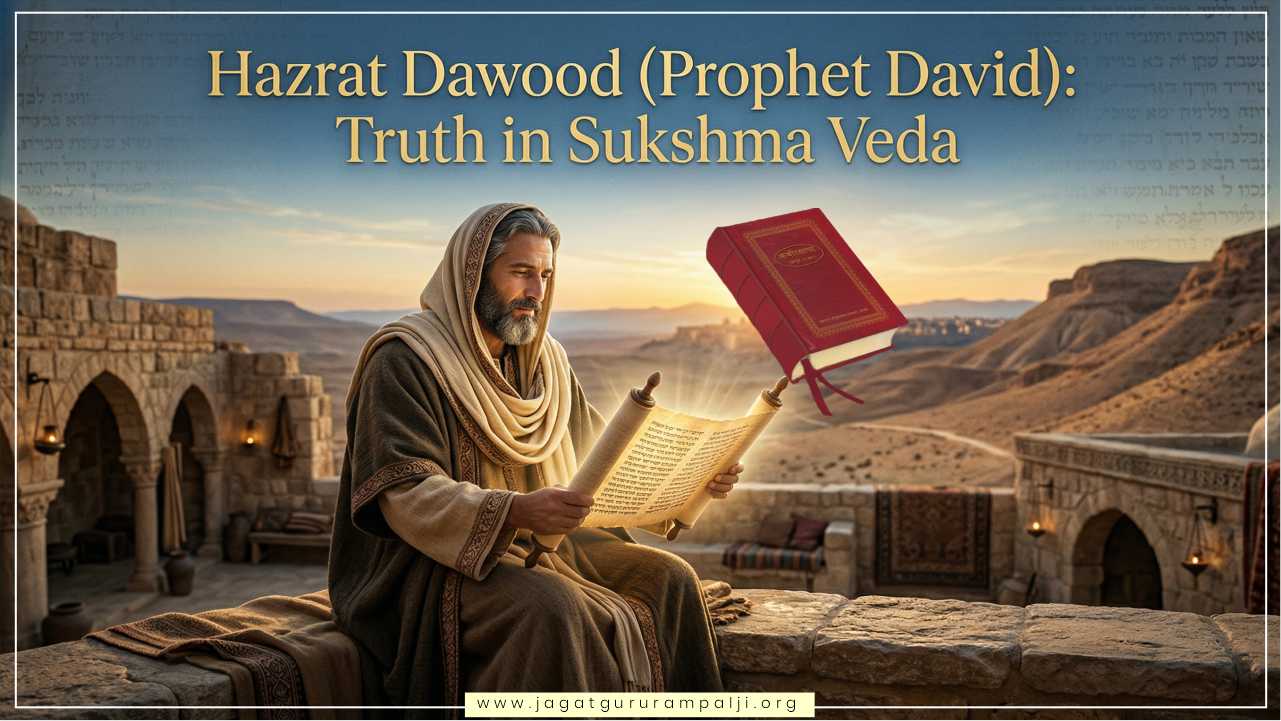
Among these Nabi, Hazrat Dawood alaihis salam (Prophet David) occupies a place of profound respect, on whom Allah bestowed the Zabur (Psalms), one of the four major holy books mentioned in Islam.
Prophet Dawud is renowned as a courageous warrior, a just ruler, and a divinely chosen messenger; his life is referenced in the Torah, the Zabur, and the Qur’an. He is deeply honoured in Islam, Judaism, and Christianity as a prophet entrusted with sacred revelation, which mainly provides information about the creation done by Allahu Akbar.
Although Dawood's life is associated with notable events and extraordinary signs across religious traditions, his true spiritual role and the extent of the knowledge he conveyed are often misunderstood. Conventional narratives tend to focus on his bravery and royal authority, while a careful, comparative study of scriptures offers a more refined understanding of his position within the divine system and the nature of the spiritual wisdom imparted through him.
This article presents a comprehensive, scripture-based understanding of Hazrat Dawood, integrating insights from the Qur’an, the Zabur, the Torah, and Biblical texts, as well as the spiritual expositions of Kabir Sagar (Sukshma Veda/ Kalam-e-Kabir) and nectar discourses of Jagatguru Tatvadarshi Sant Rampal Ji Maharaj. It clarifies the distinction between a prophet, the Supreme God, and complete spiritual knowledge, highlighting the eternal truths that transcend religion and sect.
The key points of discussion will be:-
Note: The reference has been taken from the spiritual discourses of Bakhabar Sant Rampal Ji Maharaj, Sukshma Veda - Kabir Sagar and the sacred book ‘Musalman Nahi Samjhe Gyan Quran’ written by him.
Before we proceed to reveal the scriptural reality and spiritual truth about Prophet Dawud, the messenger of Allah, it is imperative to mention that in this world we live in, there are predominantly two powers influencing creatures.
One is merciful God/ Qadar Allah Kabir (Rehman), who is the well-wisher of all creatures since all souls are His children. He is also popularly known as Al-Khidr, whose absolute knowledge is unparalleled.
Kalam-e-Kabir glorifies the creator Khuda Kabir/ Al-Khidr
Arsh Kursh par Allah takht hai Khalik bin nahi khali, Veh Paigambar pak purush they Sahib ke abdali ||
Meaning: High above, at the topmost reaches of the sky, lies the throne of Allah/ supreme God. Yet, the Lord of the Universe has access to every creature and all realms. Allah’s power is omnipresent. Nothing is hidden from the Creator. There is no place beyond God's reach. Those 180,000 prophets were truly virtuous men whom Allah blessed.
Allah Kabir introduces Himself
Hum hee Alakh Allah hai, Qutab gose aru peer।
Garib Das Khalik dhani humra naam Kabir।।
The second is the deceiver, the villain Shaitan called Jyoti Niranjan, who is cruel and rebellious to Allah Kabir. Shaitan Kaal Brahm is the Lord of only 21 universes. He is the knowledge giver of the pious Quran Sharif. This evil entity remains unmanifested and performs all his evil deeds from behind the curtain.
Due to a lack of true spiritual knowledge, naive Muslim devotees believe Allah/ Khuda is formless/ bechoon and cannot be seen. Kaal Brahm makes the good and true loyal souls of the supreme God Kabir, his prophets.
Kaal is the same Allah who revealed the sacred knowledge of the Quran to Prophet Muhammad. He also revealed the sacred knowledge of the Zabur to Prophet Dawood, the sacred knowledge of the Torah to Prophet Moses, and the sacred knowledge of the Bible to Prophet Jesus. The knowledge of the Holy Zabur, the Holy Torah and the Holy Injil was given by this same Allah (Satan Kaal) to Hazrat Dawood, Hazrat Moses and Hazrat Jesus respectively in one go, that is, it was not revealed little by little like the knowledge of the Quran. He alone is the Allah of everyone from Hazrat Adam to Hazrat Muhammad.
Important: The spiritual knowledge provided in all these holy scriptures is very little and not complete. It is only Al-Khidr/ Allah Kabir who possesses the complete spiritual knowledge.
Hazrat Dawood was a descendant of Hazrat Yaqub (Jacob), belonging to the lineage of Bani Israel, and ruled as the king of Israel. Along with his political and administrative responsibilities, he was chosen as a prophet and was granted divine wisdom. Dawood’s journey to prominence began with his miraculous victory over the giant Jalut. As mentioned in Surah Al-Baqarah (2:251), Allah gave him “the kingdom and wisdom.” This event symbolises the triumph of faith over physical might.
One of the most significant aspects of Hazrat Dawood’s mission is the revelation of the Zabur. Scriptures consistently describe him as a prophet of God and a recipient of divine revelation.
The Qur’an explicitly states:
“And We gave Dawood the Zabur.”
(Qur’an, Surah Al-Isra 17:55)
Similarly, the Torah and the Old Testament recognise him as a righteous king and prophet.
The Zabur (Psalms) is one of the four major books mentioned in the Qur’an, alongside the Torah, the Injil (Gospel), and the Qur’an itself. Surah An-Nisa (4:163) explicitly states: “…and to David We gave the Zabur.” This scripture is primarily devotional and ethical in nature. It contains prayers and hymns praising the Supreme God Kabir and provides moral guidance and ethical principles. It encourages humility, repentance, and devotion.
Unlike the Torah, which is law-based, or the Qur’an, the Zabur does not provide the complete method for liberation (moksha). Hazrat Dawood received this scripture from God Kaal, but he did not possess the full knowledge of salvation. The Bible also confirms that the Psalms (Zabur) are devotional hymns rather than a complete metaphysical explanation of creation and salvation.
A fundamental truth often overlooked is that the knowledge-giver of the Vedas, Shrimad Bhagavad Gita, Qur’an and the Bible is the same entity. The same Power, ruler of 21 universes only, delivered the Zabur to Hazrat Dawood, which contains partial knowledge confined till creation. If the book of Zabur contained complete knowledge, Allah (Kaal) would have said, "The knowledge contained in Zabur is superior to yours. It is mentioned in that chapter." However, there is no evidence for this. This proves that even the knowledge contained in the Zabur is not equal to the knowledge of Al-Khidr/ Allah Kabir.
Surah Al-Mu’minun (23:49–50) states:
Allah gave the Book to Musa so that people might receive guidance.
Isa (Jesus), son of Mary, was made a sign and given a secure dwelling.
Surah Al-Hadid (57:26–27) further clarifies:
Prophethood and scripture were placed in the progeny of Nuh (Noah) and Ibrahim (Abraham).
Later, Isa was given the Injil.
Compassion and mercy were placed in the hearts of his followers.
These verses clearly indicate a continuous chain of revelation, not separate or competing divine sources.
Al-Miraj, the divine ascension of Prophet Muhammad, is one of the most profound spiritual events in Islamic tradition. It not only signifies the exalted status of Prophet Muhammad but also provides deep insight into the existence and state of earlier prophets, including Hazrat Dawood (Prophet David). This journey demonstrates a higher spiritual reality that goes beyond ordinary human understanding of life, death, and the hereafter. This description also overrules the belief in Islam that there is no rebirth.
According to well-known Islamic narrations, one morning, Prophet Muhammad narrated his experience to his companions and said that the previous night, the angel Jabrail (Gabriel) came. He opened my chest and placed a holy object inside, and then did the same again. After that, he made me sit on a mule-like animal called Buraq and carried me through the heavens.
During this ascent, he witnessed scenes of Heaven and Hell, observed the conditions of righteous and sinful souls, and encountered Prophet Adam, who was shown looking toward both realms.
As the journey progressed, Prophet Muhammad met a vast assembly of prophets, including Hazrat Dawood, Hazrat Musa (Moses), Hazrat Isa (Jesus), and many others. Islamic traditions mention that the number of prophets present was approximately 180,000. In this grand gathering, Prophet Muhammad was honoured with leading all the prophets in prayer, symbolising his final and universal prophethood.
Sant Rampal Ji Maharaj highlights a critical spiritual conclusion from this event. If the commonly held belief were true that all souls remain unconscious in their graves until the Day of Judgment, then the presence of Hazrat Dawood and other prophets in Heaven during Al-Miraj would be impossible. Their conscious participation in the heavenly assembly clearly indicates that souls do not remain in a state of total unconsciousness after death. This event challenges the idea that Heaven (Bahisht) and Hell (Dozakh) are accessed only after the final judgment and suggests that souls experience their spiritual state much earlier, according to divine law.
Kabir Sagar contains the complete spiritual knowledge revealed by Kabir Sahib ji to Dharmadas Ji. Over time, many of its key passages were either lost or misinterpreted by followers who could not fully grasp their profound spiritual depth. Sant Rampal Ji Maharaj, through a comparative study of the Vedas, the Gita, the Puranas, the Qur’an, and the Bible, clarified that Kabir Sagar embodies the core, universal spiritual knowledge underlying all religions and presents a complete, systematic path to true liberation.
Within this framework, the concept of “Mohammad Bodh” explains the hierarchy of divine revelation through distinct spiritual stations (maqams) attained by major prophets.
(Nasoot) Mokaam 1
Bhoomi se chale jahin pahunche jaai। Mansarovar tahan kahai।।
Tahen Nasoot ahi mokama। Nabi Kabir pahunch tehi dhama।। Tahe Dawood paigambar hoyee। Jaboor kitab padhe tahan soi।। Tahin salamalek soi keena। Dastavose unhi uthi leena।।
According to this understanding, Hazrat Dawood was granted the Zabur, and his spiritual influence reached the station of Nasut, representing the earthly or physical realm of spiritual awareness. After him, Hazrat Musa received the Torah and attained Malkut, the angelic realm. Subsequently, Hazrat Isa was bestowed with the Injil and reached Jabrut, the realm of divine power. Finally, Hazrat Muhammad received the Qur’an (Furqan), and his spiritual journey reached Lahut, the realm of divinity.
It has been mentioned in Kalam-E-Kabir/ Sukshma Ved
Zabur kitab Dawood ne payee। Nasoot mokaam rahe thehrayee।।
Taurat kitab Musa ne payee। Malkoot mokaam rahe thehrayee।।
Injil kitab Isa ne payee। Jabroot mokaam rahe thehrayee।।
These four stations—Nasut, Malkut, Jabrut, and Lahut—indicate a high progression of piety within the domain of the Giver of the four Holy Books (Kaal). However, Sant Rampal Ji Maharaj further explains that beyond these lies a fifth and ultimate station known as Hahut (or Achint). This supreme realm is the eternal abode of the Almighty and represents the final destination called Satlok for a soul seeking complete and permanent salvation.
Hazrat Dawood was a noble, righteous, and highly revered Prophet-King who was blessed with divine scripture, the Zabur. His life and teachings laid a strong foundation of faith and devotion. However, the spiritual knowledge revealed to him did not include the complete method of salvation, as his mission operated within the domain of Kaal Brahm. This understanding does not diminish his honour or spiritual stature; rather, it clarifies the limitations of the revelation granted during that specific period.
A comparative study of the Bible, the Qur’an, and the teachings highlighted in Mohammad Bodh reveals that the state of “Eternal Peace” mentioned in scriptures is attained only when the soul reaches the Supreme Abode under the guidance of a True Saint. Even the Giver of the Qur’an directs seekers toward a higher authority in Surah Al-Furqan (25:59), advising them to seek a “Bakhabar/ Illamwala” (True Saint) to gain true knowledge of the Supreme God (Allah-u-Akbar), the Creator who brought the universe into existence in six days.”
Hazrat Dawud, despite being the chosen Nabi, remained in the trap of the knowledge giver of Zabur (Satan) and could not attain salvation. As the nectar speech mentioned in the Sukshma Veda by respected Sant Garib Das Ji Maharaj certifies
Peer paigambar kutub auliya, sur nar munijan gyaani |
Yeta ko to raah na paaya, jam ke bandhe praani ||"
Meaning: Even great spiritual figures such as Peers (saints), Paigambars (prophets), Kutubs and Auliyas, as well as gods, humans, sages, and scholars, did not find the true path to the Supreme Being (Satpurush). Consequently, they remained bound by the laws of Yama (the god of death) and suffered in the cycle of birth and death.
The speech emphasises that without the correct method of worship provided by a Bakhabar/ Tatvadarshi Saint (God-realized saint), even the most respected religious figures cannot escape the cycle of 84 (Chaurasi) lakh births. The devotion to Almighty/ Allah Kabir provides the definitive path to Satlok, the eternal abode, which even the mentioned Peers and Paigambars were searching for.
To attain Satlok, the seeker must seek refuge in Bakhabar. Allah Kabir Himself has descended in the realm of the knowledge giver of Zabur as Sant Rampal Ji. He is imparting true spiritual knowledge and granting true salvation mantras “Ain-Seen-Qaaf” mentioned in Surah Ash-Shura (42:2) in the Quran or “Om-Tat-Sat” in Gita 17:23 (indicative). Everyone must take His refuge and become eligible for the attainment of emancipation and reach to the higher realm of Allah Ta'ala Kabir, meaning Satlok.