

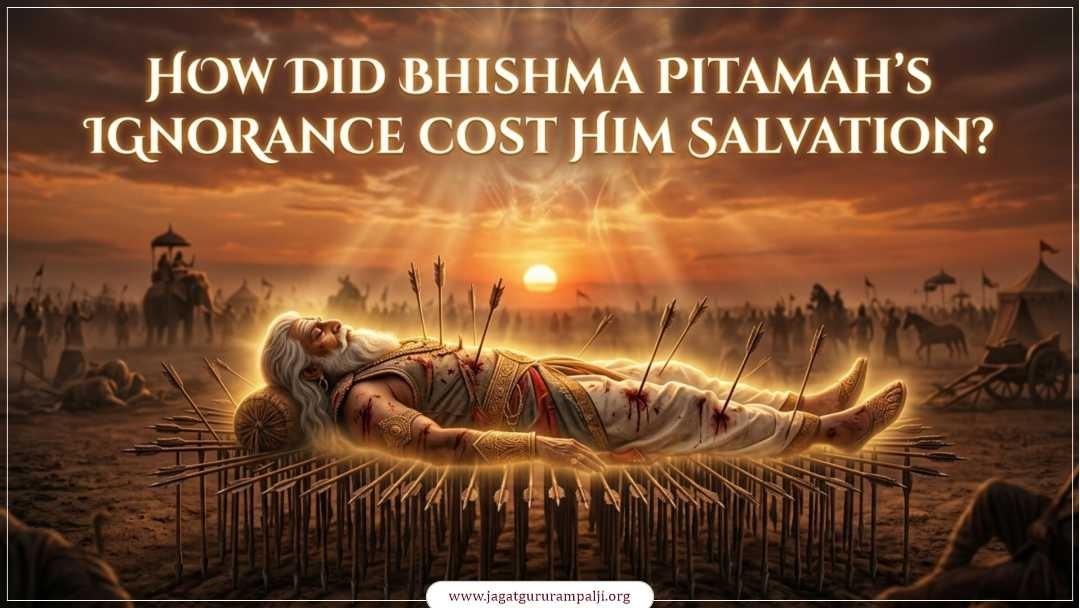
Bhishma Pitamah/ Devavrata/ Gangaputra, the most important legendary character in the Hindu epic Mahabharata during the Dwapar Yuga, is well known for his wisdom, valour and faithfulness for the throne of Hastinapur. He is considered the pillar of the Kuru dynasty who set the highest example of duty by sacrificing his desires. The oldest and most respected member of the Kuru dynasty, in spite of living a royal life, finally had a terrible demise due to the fierce mistake he committed; therefore, he fell prey to Satan Kaal.
The reason was that all the beings living in the 21 universes of Satan Kaal Brahm are bound by the law of Karma. Every incident happening in the world of Satan Kaal has already been scripted, and the movie is running. Every creature is bound to perform his/ her role. The actions performed by each being decides his/ her Karma. Accordingly, the creature is rewarded due to virtues and/ or punished because of sins in account.
This article will reveal the set-up of Brahm Kaal's realm highlighting through the life of Bhishma Pitamah that no matter a person may hold a powerful position here, may be a King or supreme commander in the army or may possess even more powers but in reality, each creature is merely a puppet in the hand of Jyoti Niranjan Kaal who deceives them by keeping them engaged in false materialistic tantrums and wastes their precious human birth which was actually provided to achieve the sole purpose of human life that was attaining salvation by performing true devotion to Almighty Kabir, the creator of entire universes.
We will also highlight that each creature wishes to attain liberation and get rid of the agony of passing through the 8.4 million species of life and the torments of hell but due to lack of true spiritual knowledge and by not finding an enlightened saint, creature does not get the true path of devotion hence, fails in his attempt to attain ultimate supreme God as happened with Bhishma Pitamah.
Let's move on and answer some frequently asked questions
Based on the following points, let's understand how Bhishma Pitamah’s life revolved according to the law of Karma of Kaal as plotted in the movie Mahabharat.
Note: The reference has been taken from the nectar sermons of Jagatguru Tatvadarshi Sant Rampal Ji Maharaj, Suksham Veda, Bhagavad Gita and the sacred books written by him.
Ref: Kabir Sagar, Chapter 24 ‘Summary of Karma Bodh’ on page no.162.
God Kabir has mentioned Karma in the Suksham Veda
Mere Hansa bhai shuddh swaroop tha jab tu aaya। Karmo ke bandhan me fans gaya tate jeev kahaya।।
God Kabir reveals that the soul became ensnared in the conspiracy of Kaal Brahm and voluntarily came from Satlok. Due to this reason, he is known as the *Jeev* (the embodied soul).
In Satlok, all materials were available without doing any work. Here, in 21 universes, Kaal Brahm has established a system of karma, which means one shall receive the fruit of one's actions only if he/ she performs deeds.
Bhagavad Gita Chapter 3, Verses 14-15 state that living beings arise from foodgrains. Foodgrains arise from rain; rain from Yagya; Yagya arise from auspicious actions, and actions arise from Brahm (Kaal). This means Kshar Purush has established the law of Karma. Brahm (Kaal) has originated from the Immortal God. It has been proved that the full benefit of Yagya is obtained from the Purna Parmatma (Kavir Dev) only.
Actions are of two types. One is termed meritorious action, and the other, sinful action.
1. Virtuous Deeds: Engaging in acts of devotion, charity, and selfless service in accordance with scriptural injunctions.
2. Sinful Deeds: Conducting oneself arbitrarily by disregarding scriptural injunctions.
Kaal Brahm has categorised the deeds of the soul into three types.
Accumulated (Sanchit) Karma, Destined (Prarabdha) Karma, and Active (Kriyavan) Karma. It is also said that the soul is free to perform actions; therefore, the soul performs 25% of its actions independently, whereas for the remaining 75%, it remains bound, which consists of Prarabdha (destined) actions.
In accordance with this very law of karma, the life of Bhishma Pitamah, too, was shaped. Moving ahead, we will prove the same with true evidence from certified holy scriptures.
According to mythological references, Bhishma Pitamah was the human incarnation of one of the eight Ashta Vasus (elemental gods) named Dyu/ Prabhasa, who was cursed by Sage Vashistha for stealing the divine cow Kamadhenu (or their daughter Nandini). The eight Vasu brothers, meaning sons of Prajapati, once visited the ashram of Rishi Vashistha along with their wives. The wife of Prabhasa/ Dyu put forth the desire to take away the Kamadhenu cow, which was aided by others. Breaking the decorum of Sage’s ashram, being a guest and stealing the cow was their biggest mistake. When Vashistha found the cow had been stolen, he cursed all eight Vasu brothers to be born as humans in the mortal realm (Mrityulok), destined to suffer deeds.
This legendary story illustrates the principle of Karma and the consequence of greed. Here, the system of Kaal’s world needs to be understood by the devotee community. Its roots are associated with the churning of the ocean.
As scripted, when the ocean of milk was churned by gods and demons, there were 14 major gems and divine objects obtained. They were divided between the gods and demons.
Halahala (or Kalakuta) was consumed by Lord Shiva, Kamadhenu cow was handed to sage Vashistha, Uchchaihshravas horse was taken by demon King Bali, Airavat elephant was accepted by Lord Indra (the King of Heaven), Kaustubha Mani was worn by Lord Vishnu, Kalpavriksha was established in Heaven, and finally Dhanvantri emerged carrying a vessel filled with nectar that was given to deities with the help of Shri Vishnu Ji and a few more things were received. All this information is well known to folks.
Hindus believe the divine cow that emerged during the churning of the ocean is a white, ‘wish-fulfilling’ cow which symbolises prosperity, power and auspiciousness. Kamadhenu/ Surabhi/ Savla is called the mother of cows. Vasu’s (Prabhas) wife got highly fascinated with the captivating beauty and uncanny ability to grant wishes by the Kamadhenu cow; hence, she desired to take it. To fulfil the wish of his wife, Dyu/ Prabhas attempted to steal the divine cow. The other seven Vasu brothers were part of this episode. Enraged with them, sage Vashistha cursed all to be born as humans and suffer.
The Vasu brothers repented and requested that the Ganga river be their mother and immediately drown them after their birth so that they may not suffer. All Vasus were reborn as humans. The Epic Mahabharata provides evidence for the same.
Dyu/ Prabhasa was, however, punished for his sin. King Shantanu of the Kuru dynasty saved his eight sons from drowning by his wife Ganga, who later became famous as Bhishma Pitamah, enduring a long life of solitude, fulfilling his duty for the throne of Hastinapur. His original name was Devavrata.
Interpretation-
Ref: Kabir Sagar Ka Sarlarth, Chapter ‘Karm Bodh Ka Saransh’, on Page no. 348-349
Bhishma Pitamah/ Devavrata was bound to stand on the side of the Kauravas, as protecting the throne of Hastinapur was his prime responsibility. To secure the marriage of his father, Shantanu to Satyavati, Devavrata had already taken a vow to remain unmarried throughout life and protect the throne of Hastinapur. Even though, in comparison to Duryodhan, Dushasan, and all the Kauravas, the Pandava brothers were dear to Bhishma Pitamah. There was a dispute over property between the Kauravas and the Pandavas.
Mandi baji khele jua, roti hi par kairo pando muva||
During the game of dice between the two cousins of the same Royal clan, Yudhishthir lost everything, including himself, his brothers Bheem, Arjuna, Nakul and Sehedeva and finally his wife Draupadi. Vindictive Duryodhan attempted to humiliate Draupadi. It has been mentioned in the Suksham Veda.
Garib, Kaoru Pandav Khilas kiya tha chaupar, bandi laao Draupadi nari pakad Arjun ki randi ||
Duryodhan ordered his younger brother Dushasana to bring Draupadi from her room, dragging and holding her hair. Duryodhan had a foul intention to strip Draupadi naked in front of the whole assembly.
Garib, Dushasan ko hukam kiya Jahan Draupadi aayee, nagan Karo is nari ko meri jaangh par do bithayee||.
Note: Draupadi had sarcastically said to Duryodhan 'The son of a blind man is also blind’. Duryodhan felt it was too insulting and became vindictive. This incident took place when Duryodhan went to meet the Pandavas in their beautiful glass palace (Sheesh Mahal) and collided with a glass wall due to a maze. Draupadi mocked Duryodhan at that time.
Duryodhan told Dushasan to bring Draupadi to him and let her sit on his thigh. At that time, the five Pandavas, 101 Kauravas, Guru Dronacharya, Karna, Bhishma Pitamah, Uncle Vidura, and other dignitaries were present in the assembly. The five Pandavas had been defeated in the gambling, and hence, were helpless as they were now slaves to Duryodhan. All were watching, but none stood up to stop Duryodhan and Dushasana.
It was Uncle Vidura, the only virtuous soul, a true gentleman in the whole assembly, who opposed the ill behaviour of Duryodhana. He said, ‘You are all brothers of the same family, same clan, why are you misbehaving with your own daughter-in-law?’ He raised his voice to protect Draupadi’s honour, saying
Vidura, Kahe ye bandhu thara, eke kul eke parivara।। Vidura ke mukh par lagya thapeda, tu to hai Pandavon ka chera।। Tu to hai bandi ka jaya||
Arrogant Duryodhan spoke ill of his uncle Vidura and went on to misbehave. Duryodhan slapped him, saying, ‘You are the son of a maid servant. Your thinking is very low, like slaves. Your thoughts are not like Kshatriyas’.
Hearing this, Bhishma Pitamah, Guru Dronacharya and Karna laughed instead of opposing and stopping Duryodhan from misbehaving. This was the fierce mistake of those three great warriors. Their act was highly disgusting. Bhishma Pitamah was so powerful and respected that if he had stood up and stopped Duryodhana saying, ‘You brothers may do anything but should not insult a woman in assembly,’ then Duryodhana would have had absolutely no standing to behave insolently towards Draupadi and Uncle Vidura in the midst of a packed assembly; yet, he remained silent like a coward. Then Vidura left the assembly.
Draupadi seeks help from Bhishma Pitamah to protect her honour, but he remains quiet. Having consumed Duryodhana's evil food, even the soul of Bhishma Pitamah had become tainted. It is said Dushasan possesses the strength equal to ten thousand elephants. Draupadi was as delicate as a Lotus flower in front of Dushasana.
She noticed that all worldly relations are incapable of saving her, so she remembered Shri Krishna at that crucial time. Dushasana attempted to disrobe Draupadi, but all his efforts went in vain since Almighty Kabir Himself, in the form of Shri Krishna, protected Draupadi’s honour. God Kabir increased the saree of Draupadi to infinite layers. It has been mentioned in the Suksham Veda
Garib, Karunamay dayal ko Draupadi ter sunayee, Jaan rahe Jagdeesh anant Jahan cheer badhaye ||
Merciful God Kabir rewarded His beloved daughter Draupadi for a piece of her saree, which she gave to God Kabir, disguised as a naked, blind sage, deep inside the river, taking a bath.
Garib, samay par Draupadi nahan gayee Ganga ke teeram, andhe ko kopen phad kar deene leeram||
God was performing a divine act to enhance the karma of Draupadi so that He could protect her at this crucial time, when, according to the script of the Mahabharata written by Satan Kaal, Draupadi had to face humiliation, and there would be no one to protect her modesty. God Kabir remains with His beloved children at times of crisis.
Garib, Dushasan Hunkare pakad kar cheer utare, ho gaye anant apaar tahan ko parda pare||
Dushasan got exhausted pulling the saree and started to sweat, and finally surrendered. There was a huge pile of sarees, and it seemed to have no end. God Kabir's miracle and blessing to Draupadi have been glorified in Sachidanand Ghan Brahm's speech
Drupad suta kun deenhe leer, jake anant badhaye cheer।|
The game of dice was over, but the ill-behaviour of Duryodhan, Dushasan and the cowardness of Bhishma Pitamah, Guru Dronacharya and Karna further ignited the Mahabharata war.
At the time, when the Kauravas and the Pandavas laid claim to their shared inheritance, meaning the Kingdom of Delhi, they stood ready to wage war; the armies of both sides stood facing each other on the battlefield of Kurukshetra. Arjuna observed that, in the opposing army, Bhishma Pitamah, Guru Dronacharya, relatives, the children of the Kauravas, sons-in-law, brothers-in-law, fathers-in-law, and others stood ready to fight and die.
Bhagavad Gita Chapter 2 Verse 4
(Arjun uvaach)
Katham’, Bheeshmm’, aham’, sankhye, Dronam’, ch, Madusoodan,
IshubhiH, prati, yotsyami, poojarhau, arisoodan ||4||
Arjuna grew despondent upon seeing his relatives on the opposite side. A saintly sentiment awakened within Arjuna, he pondered, "Is this the kingdom, to attain which we are ready to kill our cousins, nephews, sons-in-law, brothers-in-law, Grandfather Bhishma, and our Guru?. We do not even know how many days we shall remain in this world. Therefore, rather than enjoying the pleasures of a kingdom obtained in such a manner, I would prefer to sustain ourselves by begging, but I will not fight”.
Having thought this, Arjuna dropped his bow and arrows from his hands and sat down in the rear part of the chariot. (Gita Chapter 1 Verse 47)
Upon witnessing Arjun's condition, Satan Brahm Kaal entered into Shri Krishna at that very moment (Gita Chapter 2 Verse 1-3) like a ghost. He introduces himself in Gita Chapter 11, Verse 32. He delivered the knowledge of the Bhagavad Gita. .
A fierce battle was fought. Bhishma Pitamah was the commander of the Kaurava army. He bravely fought against Pandavas for 10 consecutive days, then Arjun, making Shikhabdi his shield, shot multiple arrows at his grandfather Bhishma Pitamah and laid him on the bed of arrows (Sharashaya). Even Guru Dronacharya and Karna were riddled with arrows. This was the sinful consequence of their Karma in that life itself.
Bhishma Pitamah was granted a boon by his father, Shantanu, for ‘death at will'. He remained on a bed of arrows for 58 days. It was highly painful.
Warriors like Bhishma Pitamah, Guru Dronacharya, and Karna, whose souls were tainted, who had foul intentions, who did not protect Draupadi, but rather remained seated in the assembly, intending to observe Draupadi being stripped naked, were slain in the war. It is said
Draupadi cheer haran mein kahin na aadi teethi, tantey unn teeno par Mahabharata mein aisi beeti||
All three so-called warriors had a terrible demise in war because of the sin incurred due to their cowardly act. They should have either stopped Duryodhan or left the assembly like Vidura. Then they wouldn't have incurred sin. Since they did not do so, they suffered their Karma. It has been mentioned in the Suksham Veda.
Garib, Drona Karna dei ne aadi teethi, Tate Mahabharata me Mai taru tah par itee beeti ||
Garib, Arjun mare baan pita bheesham ki chhati, baje dhundhavi naad prithvee hogi rati ||
Garib, Bheesham Pita ko Paap laga suni Draupadi ninda, Dronacharya chook padi bhoola hai banda ||
Garib, Karan pade dal mahi dahi ke Karan hai re||
18 crore soldiers died in a huge massacre in the Mahabharata war. All the Kauravas were killed in the war, and the Pandavas emerged victorious. Suksham Veda certifies
Duryodhan se Raja hote, sang ekottar bhai। Gyarah akshoni sang chale thee, dehi gidh na khayee||
When Lord Krishna Himself urged Yudhishthira, the eldest of the Pandavas, to ascend the royal throne, Yudhishthira refused to accept, declaring, "I will not rule over a sinful kingdom stained in blood in which millions of people were killed. Their wives were widowed, and millions of children were orphaned; their tears have not yet dried.
Lord Krishna noticed that a resolution could not be reached in any manner, so he suggested that Yudhishthira seek advice from Bhishma Pitamah because whenever a person is unable to decide on his own, he should consult with a kinsman. Yudhishthira agreed with Krishna. Then, Lord Krishna took Yudhishthira along and arrived at the place where Bhishma lay, counting his final breaths upon a bed of arrows.
Shri Krishna said to Bhishma Pitamah, ‘Yudhishthira is refusing to ascend the throne. Kindly educate him about diplomacy.’ Bhishma Pitamah endeavoured a lot to persuade him, preached to him Raja Dharma, yet Yudhishthira remained unswayed from his decision. He persisted in declaring, "I have no desire to attain hell by enjoying a kingdom stained with blood and tainted by such sin." Shri Krishna suggested that Yudhishthira perform a Yagya so that he may not incur the sins of killing in the war. Yudhishthira agreed and performed a religious ritual. He ascended the throne and became the King of Hastinapur.
Bhishma Pitamah took a fierce vow of lifelong celibacy for the sake of his father's happiness, earning him the name ‘Bhishma’. He had a boon of ‘voluntary death’ (Iccha Mrityu). He remained on the bed of arrows (Sharashayya) for 58 days, waiting for the right time to renounce his body. He had the boon to choose the time of his death.
There is a myth in Hinduism spread by agents of Kaal, meaning fake religious gurus, regarding Moksha/ Nirvana. For ages, the spiritually blind gurus, Acharyas, Mandaleshwars, sages, and Mahants who remained far from true spiritual knowledge, with Kaal’s inspiration, have given a wrong theory of attaining salvation. They say ‘those who die during Uttarayan, the day of solar solstice (Makar Sankranti), attain liberation from rebirth and go directly to the supreme Being. On the other hand, those who die during Dakshinayan remain in the cycle of birth-rebirth. They return to Earth.
Since humans suffer their Karma in Mrityu Lok, therefore, based on the same myth and according to the mythological references, it has been found that Bhishma Pitamah, intending to attain emancipation, chose the most sacred and auspicious day of his death since he was blessed with ‘death at will’. Bearing the severe pain on the bed of arrows, on the 58th day, when the sun moved towards the north, which is considered (myth) the ‘day of Gods or the door to salvation’, he gave up his life.
The evidence mentioned in the Suksham Veda and the Bhagavad Gita denies such theories associated with salvation. The certified ancient holy scriptures clearly mention that Almighty Kavir Dev, the creator of the entire universe, is the provider of Salvation. He is mentioned in Bhagavad Gita 15:16 & 17, 18:62 and Rigveda Mandal 10 Sukt 4 mantra 3 and 4, Rigveda Mandal 9 Sukt 96 mantra 17, 18 and at several other places. He is attained by chanting salvation mantras (coded) mentioned in Gita 17:23. This secret true mantra is decoded only by an enlightened saint/ Tatvadarshi Sant whose identity has been mentioned in Gita 15:1-4.
Salvation/ Supreme God can never be attained by any other practice. Since there is no evidence that Bhishma Pitamah did true devotion to Almighty Kavir Dev and chanted true salvation mantras Satnaam and Sarnaam, it is clear that he failed to attain salvation and remained in the trap of Brahm Kaal.
The script of the Mahabharat movie, as prepared by Kaal, moved as planned. The soul of Bhishma Pitamah, who was once at the post of God/ Vasu Dyu, suffered as a human being due to a curse by sage Vashistha. This signifies the creatures are puppets in his hand.
God Kabir Himself says
Karma rekh tari na tare।
Unless the soul takes refuge in Satguru/ true spiritual guru who is the ultimate supreme God Himself or His authorised representative, till then the soul keeps suffering in 8.4 million life-species and hell. He bears the consequences of his/ her Karma.
It has been mentioned in Chapter ‘Karm Bodh’ on page no.165
Kabir, Karm phans chhote nahi, keto karo upaye। Sadguru mile to ubre, nahi to pralay jaye ।।
The supreme God Kavir Dev, as per His divine law, comes on earth in every Era. In Dwapar Yuga, God Kavir came in the form of Sage Karunamay and took Vidura and a few more souls in His refuge. He also met five Pandavas, Draupadi, and Shri Krishna. Had Bhishma Pitamah also taken God’s refuge, then he would have also become eligible for the attainment of salvation.

At present, Almighty Kavir Dev has descended from His immortal world Satlok to the 21 universes of Kaal. He is performing a divine act in the form of Jagatguru Tatvadarshi Sant Rampal Ji Maharaj in the holy land of Haryana, India. His disciples are in crores who are receiving miraculous benefits day and night. All God-loving souls are advised to take His refuge, do His true devotion to attain salvation, with which Bhishma Pitamah remains deprived. God Kabir Sahib assures everyone who performs His true devotion by remaining in the prescribed rules of devotion will attain Satlok, which is the native place of all souls.