

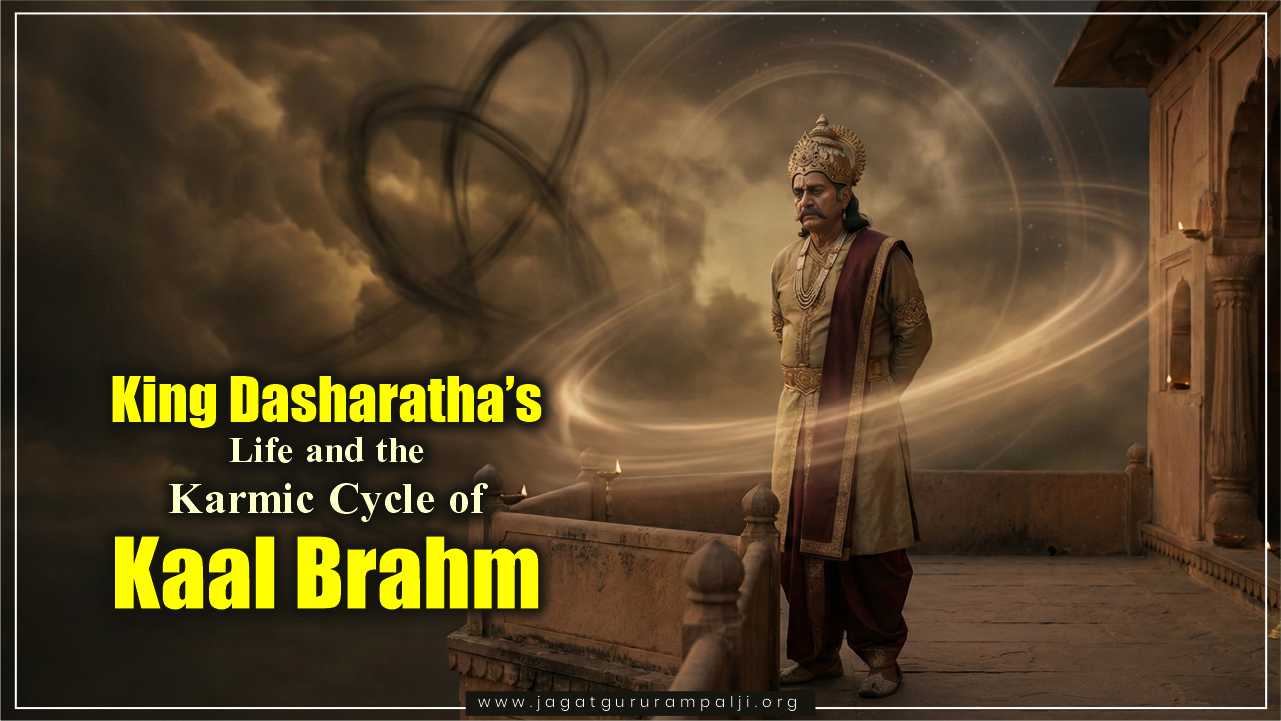
Maharaja of Kosala running his Kingdom from its capital Ayodhya belonging to the Solar Dynasty, Raghukulvanshi King Dasharatha/ Nemi, the son of Aja (father) and Indumati (mother) in Treta Yuga, is a renowned figure in the Hindu Epic Ramayana whose life story revolves around the Karmic cycle as plotted by the owner of 21 universes, Brahm Kaal. This Satan Kaal determines the human life of every soul in this similar way, by taking the average of existing virtues and sins in an individual's account in equal ratio. As a result, the happiness and sorrows in an individual's life are fixed.
In this article, the focus will be on highlighting a few life events that occurred in the life of Suryavansha King Dasharatha/ Nemi, which confirm that each trapped soul in the dangerous web is merely a puppet in the hands of Kaal and events happening in 21 universes run like a film whose script writer is Kaal himself. He keeps souls engaged in arbitrary worship with which no spiritual benefit is gained, and creatures remain trapped in vicious cycles of birth-rebirth, as was the case with King Dasharatha.
Based on the following points, let us know all about King Dasharatha.
Note: The reference has been taken from Shri Ramcharitmanas, Sukshma Veda, Puranas, Shrimad Bhagavad Gita, nectar sermons of Jagatguru Tatvadarshi Sant Rampal Ji Maharaj and the sacred book ‘Kabir Sagar Ka Sarlarth’ written by him.
King Dasharatha, born Nemi in Treta Yuga, hailed from the Ikshvaku dynasty. It is believed that he was an incarnation of Manu, the mind-born son of Lord Brahma. Being a great warrior who slew several demons (Assura) in war with deities (Devas), he obtained the appellation Dasharatha (10 chariots) since his amazing chariot could move, fly in all ten directions and finally return easily to earth.
It has been mentioned in Suksham Veda in Chapter ‘Samay Sanyog Ka Ang’
Garib, samay par Kaikeyi kanth apne mukh choosya angootha, samay par hue vish kanth||
Samay par Dashrath toothya||
Garib, samay par Vach trivach kahi Dashrath ko vani, samay par bharat ko raaj dashte sarang pani||
It is said that once King Dasharatha was fighting a war with another king. His thumb got injured and Kaikeyi sucked it to stop the bleeding, which boosted Dashrath's morale.
Second well-known episodes in the life of King Dasharatha was when he, along with his third wife Kaikeyi, bravely fought for Lord Indra and defeated monsters (Asuras). Kaikeyi showed her valour and dedication in that battle by keeping steady one of the slipped wheels of that amazing chariot by inserting her thumb in the hole from where the bolt of one wheel had slipped, so that it should not disengage, and Nemi/ Dashratha should not lose the battle. Dashrath highly appreciated this support from Kaikeyi and offered her two boons, which Kaikeyi demanded later, which proved fatal for King Dashrath.
The legendary belief that King Dashrath and his queen consort Kaushalya in Treta Yuga were the incarnations of Manu and Shatarupa in Satyuga. Both received a blessing from their respective deity, Lord Vishnu, to serve him as their son in the Treta Yuga. As a result, both served Shri Ramchandra, the incarnation of Vishnu, as their son.
Note: All these events are scripted by Kaal well in advance, and the activities run like a film. Based on deeds performed by all creatures in 21 universes, the virtues and sins are added to individuals' accounts, which they have to bear in each human life.
Ref: Kabir Sagar ka Sarlarth, chapter 24 "Summary of Karm Bodh” page 162 certifies that here in 21 universes God Kaal Brahm/ Kshar Purush has established the law of Karma. All living beings are produced from food (Srimad Bhagavad Gita Chapter 3, verses 14-15). By eating food, seed (semen) is formed from which all living beings are born. Each being remains tied up in the karmic cycle originated by Kaal. Whatever deeds (virtues and sins) a living being does, he/she gets reward and punishment accordingly.
Kaal Brahm has divided the deeds of a living being into three types:
Accumulated (Sanchit) Karma, Predestined (Prarabdha) Karma and Actionable (Kriyawan) Karma. Together with these, the living beings also perform some independent actions (swatantra karma).
The life of King Dasharatha was no exception since it was also based on these types of Karmas. A few events in his life discussed ahead will make the picture clear. Let us go through them and understand how Brahm Kaal designed the life of Dasharatha based on his Karma.
Sage Shringi was a well-known acetic in Treta Yuga, a Siddh Purush who practised khechari mudra and perfected Amrit Kriya (Nectar drinking), thereby awakening Kundalini Shakti/ Nagini Shakti (blooming of Navel Lotus). Due to this accomplishment gained through Hatha Yoga, he gained the power to survive on a meagre diet. He used to lick the bark of a tree once a day. He used to be satiated with it, but does not use to open his eyes, rather continues to meditate all the time.
Important: God-loving souls do such sadhna intending to attain God, but this is an arbitrary worship. In the absence of true spiritual knowledge and not finding a Satguru, seekers perform Hatha Yoga, which fails to provide them with fruitful results. This is Kaal Brahm’s set-up.
Sage Shringi became quite famous near Ayodhya as he used to practice sadhna in the outskirts of Ayodhya.
Shanta was the daughter of King Dasharatha, and with his permission, she used to go to serve food to Rishyasringa/ Shringi Rishi. A wise man suggested to Shanta that she should apply honey on that part of the tree which the sage licks once a day so that he opens his eyes. Shanta did the same for three days, and finally, the sage, after licking honey, opened his eyes. He saw Shanta and other people standing in front. She introduced herself to the sage.
King Dasharatha requested Sage Shringi to come to his palace and allow them to serve him. Sage Shringi gave consent. Shanta was allocated the responsibility to serve the sage. Gradually, both developed an affection for each other and decided to marry.
Since Shringi Ji was a Brahman and Shanta a Kshatriya, their caste difference became a hindrance in their marriage. One Brahmin sage provided the solution. He adopted Shanta as his daughter, then King Dasharatha married Shanta to Rishyasringa/ Shringi Rishi.
Rishyasringa/ Shringi Rishi performed the Putrakameshti Yagya for King Dasharatha on his request to have a son. An auspicious time was fixed for the religious ritual. After its successful completion, four sons were born to King Dasharatha from his three queens, Kaushalya, Sumitra and Kaikeyi. This is a well-known story.
Note: The birth of Vishnu Ji as Ram was the destined (Prarabdh) Karma of Dashratha.
Guru Vashistha, the royal family priest (Kulpurohit) of Suryavansha Dasharatha, did the naming ceremony of King's four sons. Although Guru Vashistha did not liked the work of Purohit as evidenced in Ramcharitmanas, Uttarakhand, Doha 47, Chaupai 3 therefore denied initially but he agreed to hold this responsibility due to ignorance of his father Shri Brahma Ji who mistakenly believed Shri Vishnu Ji to be the supreme God who will incarnate in Treta Yuga and will be born as a son to King Dasharatha and queen Kaushalya. Evidence of this is found in the Ramcharit Manas, Uttarakhand, Doha 47, Chaupai 4.
Thereafter, Vashistha Ji started assisting Dashratha in all religious rituals for the family, be it the birth of a child, education, marriage or the death of a family member.
In this connection, by mistake, Guru Vashistha Ji named the four sons of Dashrath on the basis of the qualities mentioned in the Vedas about the supreme God. The evidence for this is found in the Ramcharit Manas Balakanda, Doha 196-197
Important: Actually, none of the four sons of King Dashratha/ Nemi possess these qualities. Only Aadi Ram Kavir Dev, the supreme God, creator of the entire universe, possesses these qualities.
Important: King Dasharatha performed a yajna (sacrifice). This was an actionable (Kriyavan) karma, independent karma to obtain a worthy son. His other children were three sons, Bharata, Lakshmana, Shatrughna and a daughter, Shanta. Dasharatha obtained rest four children as was destined (Prarabdh Karma).
Evidences from Durga Purana, Shiv Purana, Markandeya Purana, Vishnu Purana and the pious Shrimad Bhagavad Gita certify that the Hindu Triumvirate Brahma, Vishnu, and Shiva are mortal. Shri Vishnu, born as Ram, the son of King Dasharatha in the Tretayug, was not the supreme God. Worshipping Lord Ram does not provide any spiritual benefit to seekers. Only Aadi Ram, the primordial God Kavir Dev, is worshipable. This truth also certifies that Ram mentioned in the Vedas is not the same Ram who was the son of Dasharatha of Tretayuga.
It is said about Aadi Ram
Ek Ram Dashrath ka beta, Ek Ram ghat-ghat mein baitha, Ek Ram ka sakal pasara, Ek Ram duniya se nyara
Instead of worshipping Dasharatha's son Ram Chandra, devotees should perform true devotion to Aadi Ram, who is the provider of emancipation.
Once, King Dasharatha was guarding a lake at night. Since the sages, saints used to drink water from that lake, and the wild animals should not spoil it, therefore, Dasharatha himself was guarding it because he believed that he got sons Shri Ramchandra, Lakshman, Bharat and Shatrughan with the blessings of the sages. Pious soul Dasharatha had a special respect for sages.
Shravan Kumar, a noble son, had set out for pilgrimage carrying his blind mother and father in a palanquin for them to have a holy bath. On the way, his parents felt thirsty and asked Shravan to arrange water for them. In the dark night, Shravan took a pot of water to the lake and began filling it. Hearing his voice, King Dasharatha, thinking it to be a wild animal, shot a word-piercing (Shabdbhedi baan) arrow which hit Shravan, and he fell down saying 'Hey Ram'.
King Dasharatha had shot the arrow, mistaking it for an animal. Hearing the cry of "Hey Ram", he realised that the arrow had struck a person and not an animal. King Dasharatha went and saw that Shravan was screaming with pain. He said to Dasharatha, "I won't survive. My parents are blind and very thirsty. Please give them water, but do not tell them that your son has died, else they won't drink water and will die of thirst". Saying this, Shravan died.
King Dasharatha went to Shravan's parents and offered them water, but did not say anything. The parents said, "Son, why aren't you speaking? It seems you're fed up with us. Tell us the truth. If you're upset, leave us here and go home. We do not want to trouble you further. We will not drink water until you speak".
King Dasharatha was forced to tell the truth. The mother and father broke with the news of the death of their son, hence cursed King Dasharatha, saying, 'As today we are giving up our life in separation from our son, one day you too will die in separation from your son’.
Although King Dasharatha apologised and promised that he would take good care of both of them, he would keep attendants in their service, yet they did not agree. Both the mother and father bitterly wept and gave up their life.
Note: A Few accomplished true seekers possess powers that they misuse by cursing others out of anger or maybe arrogance. This is a huge trap of Kaal which needs to be understood. One who curses someone and one who is cursed, both suffer its consequences.
The film Ramayana, as scripted by Kaal, flashes back to King Dasharatha’s two boons offered to Queen Kaikeyi, who demanded 14 years of exile for Lord Ram and granted the throne of Ayodhya to her son Bharat.
The time arrived for the boon by Dashrath and the curse inflicted on him to come true. He had to suffer the consequences of these deeds in his own life.
When Lord Rama went into exile, King Dasharatha climbed to the highest terrace (chaubare) of his palace and watched Ram leaving the palace along with his wife Sita and younger brother Laxman. When Lord Rama disappeared, Dasharatha stood on the parapet of the courtyard. Standing on his toes, he bent a bit, looked at his son, and then fell down and died.
Important: This was not King Dasharatha's destiny. This incident was due to his actionable (kriyavan) Karma. Due to the curse of Shravan’s parents, King Dasharatha died prematurely in an accident. The boon to Kaikeyi also became fatal for Dashrath. The vice-like affection for his son Ram Chandra became the reason for his demise.
Note: In this way, several vices dominate in each creature, and Kaal takes full advantage of them and ruins the Karmas of each being.
Shri Ram was the eldest son of King Dasharatha. According to the belief in Hindus, the eldest son performs the last rites. This ritual is done for the liberation of the soul. This belief is an outcome of sheer ignorance due to a lack of Tatvgyan. Such activities and rituals are arbitrary and strictly prohibited in Bhagavad Gita 16:23&24.
Lord Ram did not perform the last rites of King Dasharatha. Does it mean Dasharatha was not cremated?
No, the cremation of the dead body of Dasharatha was done. Due to unscriptural devotion done by him, and with the effect of the curse, Dasharatha received the birth of a ghost or ancestor. The evidence from holy scriptures confirms that when Sita Ji performed the veneration of her ancestors during her exile, King Dasharatha was also seen sitting in the line of ancestors. King Dasharatha's death was the result of his current (kiryavan) karma.
Note: Attaining Salvation by carrying out Shraddha of deceased ancestors is a myth. No holy scripture provides any evidence for this arbitrary ritual. Salvation is only attained by the true devotion of the supreme God, Satpurush Kavir Dev.
The life of King Dashrath clarifies the karmic cycle of Kaal Brahm, which cannot be altered unless the seeker performs true devotion to Aadi Ram, Kavir Dev. God Kabir is all capable and has the veto power to alter the destiny of His true worshippers.
Param Akshar Brahm, Satpurush, Aadi Ram has descended on Earth from His immortal realm, Satlok, in the form of Jagatguru Tatvadarshi Sant Rampal Ji Maharaj in Haryana, India, within Kaal Brahm’s 21 universes. He is granting true spiritual knowledge and true salvation mantras chanting, which no devotee will attain pitra yoni like Dashratha. All devotees will be relieved from Kaal's dangerous trap and will go to their native place, Satlok.