

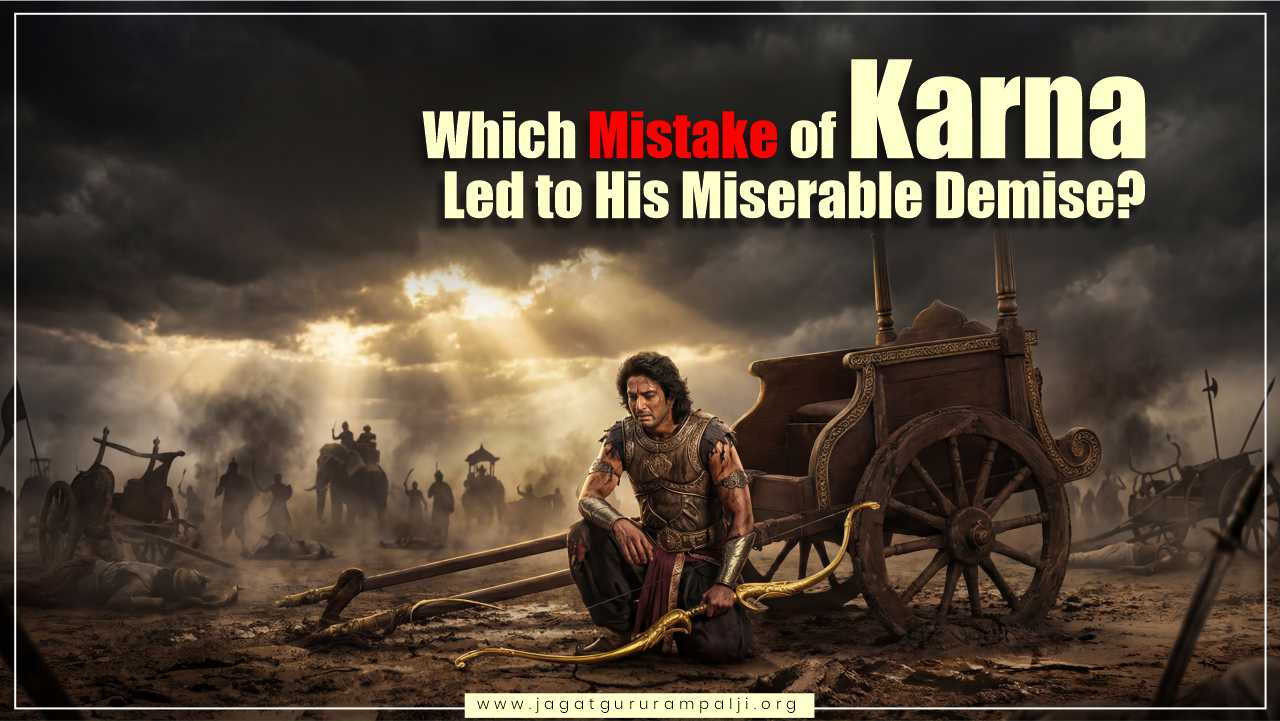
Karna/ Vasusena/ Anga-Raja/ Sutaputra/ Radheya, portrayed as a tragic figure in the Hindu epic Mahabharata, was the first son of Kunti (born before her marriage) and Lord Surya. Karna's divine birth remained a point of conflict throughout his life. He was called a Sutaputra due to his upbringing in a low-caste family by Charlotteer Adhiratha, who found him in a basket floating in the Ganga River after Kunti abandoned infant Karna due to public shame.
Although he was well known for his unparalleled generosity which led him to surrender his Kavach-Kundal (divine armor he had since birth) to Lord Indra who asked for it out of a trick disguised as a Brahmin, Karna was also duly given respect for his unwavering loyalty to his friend Duryodhan who made him the King of ‘Anga’ therefore, he got bound to remain firm to Kauravas and went against his half-brothers, Pandavas in the war at Kurukshetra in Dwaparyuga. This story is well-known to folks.
The most important point to ponder here about Karna is, when he was a master archer who was skilled in all warfare arts, why did he have such a miserable demise?. People attribute his tragic end to the result of several societal rejections and curses he faced.
The truth is, it was a game plan of Satan Kaal, whose law in his 21 universes is based on Karma. Evidence in Suksham Veda, Kabir Sagar ka Sarlarth, Chapter 24 "Summary of Karm Bodh” page no.162
The actions performed by each soul in his/ her human life add on to their virtues and sins, which become their accumulated (Sanchit) Karma. In each consecutive human life obtained after suffering in 84 lakh life-forms, the soul's life is determined, and the average of virtues and sins is taken, which becomes his/ her pre-destined (Prarabdh) Karma, which they have to bear. If virtues are more in account, the individual leads a happy life on earth and if sins/ evils are in abundance, the individual spends a tough human life. Together with these two, there are some actionable (Kriyavan) Karma and independent (swatantra) Karma. The person gets punishment and/ or reward of independent Karma in the same human life.
Proceeding to answer this often asked question, in this article, we will provide information about the reason for the tragic end of warrior Karna, which was the outcome of his ‘Swatantra’ Karma/ independent action.
Note: The reference has been taken from the spiritual discourses of Jagatguru Tatvadarshi Sant Rampal Ji Maharaj and Suksham Veda.
In the Dwaparyuga, the dynastic rivalry between cousins of the same Royal family, the Pandavas and Kauravas, over the throne of Hastinapur became the reason for the Mahabharata war. Karna plays an important role in the war. The script of this film was written by Devil Kaal well in advance. All characters simply played their roles.
Facing several societal rejections due to the conflict between his divine birth and upbringing in a low-caste family, when Karna received the support of Duryodhan and became the King of ‘Anga’, his prime responsibility was to remain steadfast to his friend Duryodhan, who was the symbol of unrighteousness. Since Arjuna was Karna's biggest rival, he always stood at the side of the Kauravas, who were also jealous and vindictive to the Pandavas.
Ref: Kabir Sagar Ka Sarlarth on page no. 348-350
The assembly was all set for the game of dice to be played between the Kauravas and the Pandavas, in which great warriors like Bhishma Pitamah, Guru Dronacharya, Karna, Uncle Vidura and several other dignitaries were present. In this gambling, Yudhishthir lost everything, his entire Kingdom including himself, even all four brothers Bheem, Arjuna, Nakul, and Sehedeva and finally Draupadi.
Duryodhan, the eldest son of Dhritrashtra, intending to humiliate Draupadi in front of everyone present in the assembly, instructed his younger brother Dushasan to bring Draupadi to the assembly. He ill-spoken about Draupadi as evidenced in the speech mentioned in the Suksham Veda
Garib, Kaoru Pandav Khilas kiya tha chaupar, bandi laao Draupadi nari pakad Arjun ki randi ||
Garib, Dushasan ko hukam kiya Jahan Draupadi aayee, nagan Karo is nari ko meri jaangh par do bithayee||
Duryodhan brought Draupadi from her room, dragging, holding her hair and following his brother's order, attempted to disrobe her in front of all dignitaries present at that time. When uncle Vidura strongly opposed, Duryodhan misbehaved with him, saying, ‘You are the son of a maid servant. You always stand in support of the Pandavas.
Hearing this, Bhishma Pitamah, Guru Dronacharya and Karna laughed. Duryodhan stood up and thrashed uncle Vidura. Finally, Vidura, the gentleman, left as he could not see Draupadi's humiliation. It has been mentioned in the Suksham Veda
Vidura Kahe ye bandhu thara, eke kul eke parivara।। Vidura ke mukh par lagya thapeda, tu to hai Pandavon ka chera।। Tu to hai bandi ka jaya||
The behaviour of all three- Bhishma Pitamah, Guru Dronacharya and Karna was highly shameful. Instead of opposing and stopping Duryodhan not to cross limits of Ill-mannerism those three giggled. If either of the three had stood up and strictly scolded Duryodhan, ‘You brothers can do whatever you want among yourselves, but mistreating a woman in the assembly is not right; it is against the principle of Kshatriyas’. Then, what audacity did the Kauravas have to even touch Draupadi's garment? They didn't react at all, but rather just sat quietly watching Draupadi's disrobing.
Point to Ponder- What does their presence in the assembly signify?
It reveals the extreme depravity of their minds. They were sitting there to witness Draupadi's humiliation in front of everyone or what else? Their souls had become sinful by eating the evil food of Duryodhan. This was the reason why all three (Dronacharya, Bhishma, and Karna) were riddled with arrows. This was the consequence of the sins they committed in that very human life. They should have stopped Duryodhan, or else they should have left the assembly like Uncle Vidura. Then they would not have been partakers of sin.
Karna supported the unrighteous Duryodhan and became a partner in Draupadi's humiliation. Due to this independent action/ Swatantra Karma, he had a tough time in the Mahabharata war at the Kurukshetra battlefield. Respected Sant Garib Das Ji Maharaj describes the pitiable condition of Karna, Guru Dronacharya and Bhishm Pitamah in the war.
Garib, Drona Karna dei ne aadi teethi, Tate Mahabharata me Mai taru tah par itee beeti ||
Garib, Arjun mare baan pita bheesham ki chhati, baje dhundhavi naad prithvee hogi rati ||
Garib, Bheesham Pita ko Paap laga suni Draupadi ninda, Dronacharya chook padi bhoola hai banda ||
Garib, Karan pade dal mahi dahi ke Karan hai re||
Important: The supreme God Kabir acquiring the form of Lord Krishna, protected the honour of His most beloved daughter Draupadi in that assembly by increasing her saree to infinite layers. She had been in the shelter of God Kabir in previous human births. In that present life also she did a noble deed for God Kabir who was in blind sage-form, by saving His honour (a spectacle performed by God Kabir in which she gave a piece of cloth of her saree to cover His private part when he was nude deep inside water) therefore, she was blessed as God granted her the reward of her Karma). Dushasan finally surrendered as he could not disrobe Draupadi.
Garib, samay par Draupadi nahan gayee Ganga ke teeram, andhe ko kopen phad kar deene leeram||
Draupad suta ko deene leer jake anant badhaye cheer||
Karna's tragic end could not be averted as he did not perform true devotion to God Kabir. Whereas Draupadi remained unharmed. Unless the person practices true devotion to Almighty Kabir, there cannot be any change in his/ her deeds. As God Kabir Himself says
Karma rekh tari na tare।
Param Akshar Brahm/Satpurush Kavir Dev, who alters the Karma of His true devotees, has descended from His eternal abode, Satlok, into Kaal's realm and is performing divine play in the form of Jagatguru Tatvadarshi Sant Rampal Ji Maharaj in the holy land of Haryana, India. He has brought miraculous differences in the lives of His disciples by the power of His true devotion. It is advice to all readers: take His refuge, for He is the Saviour of the world. He is Bandichhor, the liberator of souls from Kaal's Karmic cycle. God assures whoever will take His refuge and will do His true devotion till their last breath and will remain in the decorum will surely attain salvation and reach Satlok. That creature will get permanent relief from the vicious cycle of birth-rebirth.